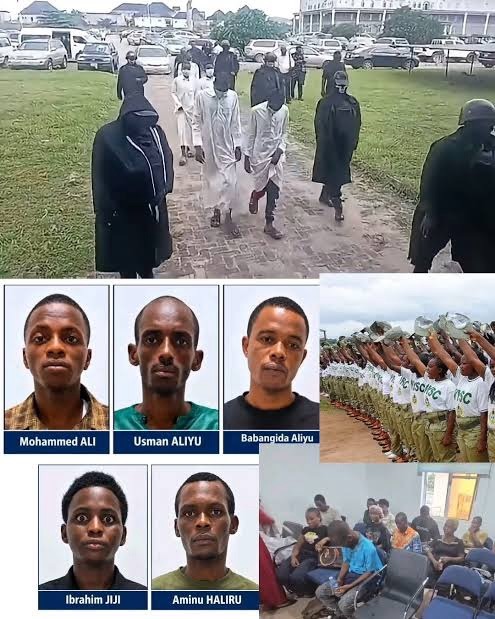
The Department of State Services (DSS) has arraigned five suspects before the Imo State High Court over the alleged abduction of 20 prospective National Youth Service Corps (NYSC) members and four other persons in Imo State.
The suspects were brought before the court on Tuesday, October 20, 2026, to face charges relating to conspiracy, hostage-taking and unlawful possession of firearms in two separate cases.
According to reports, three of the defendants, Usman Aliyu, 25, also known as Chonge; Babangida Aliyu, 21; and Mohammed Ali, 23, alias Smallie Pepper, were accused of abducting the prospective corps members on October 1, Nigeria’s Independence Day.
The victims were travelling from Ibadan, Oyo State, to their assigned NYSC orientation camps in Abia and Akwa Ibom states when they were abducted along the Owerri-Mgbidi-Onitsha Expressway. They were rescued seven days later during a joint security operation.
The three defendants were also accused of unlawfully possessing three AK-47 rifles, four magazines, a pistol and 81 rounds of live ammunition.
In a separate case, Aminu Haliru, 27, and Tange Ibrahim, 20, also known as Jijji, were arraigned over the alleged abduction of four persons around Owerri and Mgbidi on October 4.
The prosecution alleged that the two defendants and other suspects still at large collected ₦8 million for the release of the four victims. They were also accused of unlawfully possessing an AK-47 rifle and a pump-action gun.
The DSS said the suspects were arrested during intelligence-led operations conducted between October 10 and 14 in Port Harcourt, Rivers State, and Aba, Abia State, with the support of other security agencies.
Three other suspected members of the criminal gang reportedly escaped during the operations with varying degrees of gunshot injuries, prompting a manhunt for them.
The arraignment marks another step in the investigation into the abduction, which raised concerns over the safety of prospective corps members travelling to their orientation camps.
The charges remain allegations, and the defendants are presumed innocent until proven guilty by a court of law.