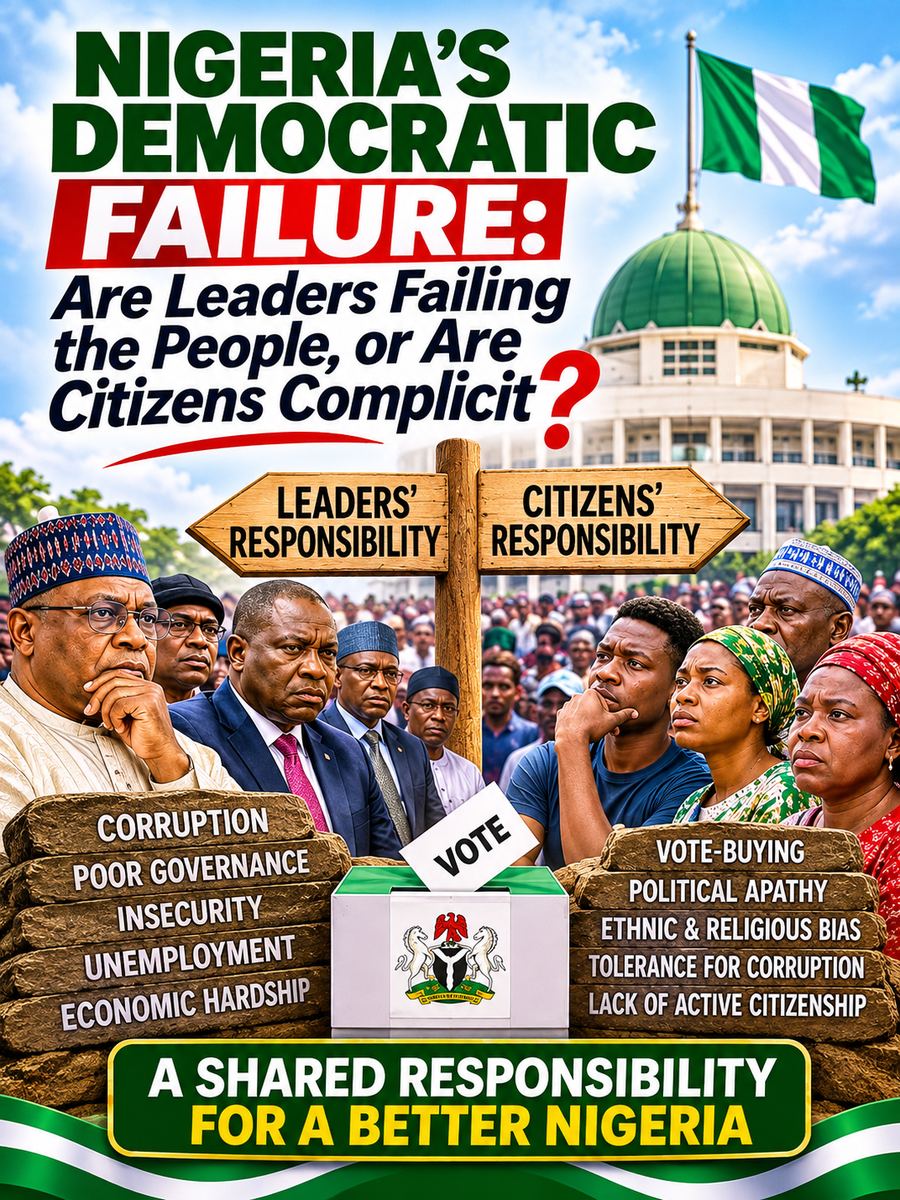
Nigeria’s democratic experience raises an uncomfortable question that deserves more attention than the usual exchange of political accusations: are the country’s problems entirely the fault of its leaders, or have citizens also become part of the culture that sustains poor governance? It is tempting to place the entire burden on politicians, particularly in a country where economic hardship, insecurity, unemployment, deteriorating public services and concerns about accountability continue to shape everyday life. However, while leadership failure remains a significant part of Nigeria’s challenges, examining the country’s democratic shortcomings without considering the conduct and choices of its citizens would leave an important part of the conversation unresolved.
Democracy is built on the principle that political power belongs to the people, who exercise that power through elected representatives. The President, governors, senators, members of the House of Representatives, state lawmakers, local government chairmen and councillors are entrusted with public responsibilities through the electoral process. Their mandate is not a personal entitlement or a reward for political loyalty. It is a responsibility to represent the interests of the people, make decisions in the public interest and remain accountable for the exercise of their authority. Yet, in Nigeria, the relationship between elected officials and their constituents often appears strongest during election campaigns and considerably weaker after political victories have been secured. Constituency visits, empowerment programmes and distributions of food items may provide immediate relief, but they cannot substitute for effective representation, legislative oversight, quality lawmaking and sustained engagement with the people. A lawmaker’s effectiveness should not be measured by the frequency of photographs taken with constituents or the volume of gifts distributed, but by the quality of representation and the performance of constitutional responsibilities.
The problem extends beyond individual office holders to the institutions and political parties that shape the democratic process. The legislature, for instance, is expected to scrutinise government expenditure, examine proposed policies and hold the executive accountable. Its responsibility is not to provide automatic approval for government decisions or become an extension of the ruling party’s political machinery. Similarly, political parties must demonstrate that they are capable of promoting internal democracy, producing credible candidates and managing disagreements through transparent processes. Recent developments surrounding the African Democratic Congress and the legal dispute over its leadership and Atiku Abubakar’s candidacy ahead of the 2027 elections illustrate how internal party conflicts can become distractions for the electoral process. INEC Chairman, Professor Joash Amupitan, has maintained that the commission will comply with binding court decisions on the matter. Meanwhile, the commission’s planned November 28 mock presidential election exercise is an opportunity to test improvements to its electoral technology and address concerns arising from the 2023 elections. These developments reinforce the importance of credible institutions, respect for the rule of law and transparency in the management of political affairs.
Nevertheless, citizens cannot claim complete innocence in the democratic culture they help sustain. Vote-buying, political violence, the deliberate circulation of misinformation and the tendency to defend misconduct because it comes from a preferred political party all weaken accountability. When voters prioritise immediate financial benefits over competence and integrity, they make it easier for politicians to treat elections as commercial transactions rather than opportunities to earn public trust. When supporters excuse corruption in their political camp while condemning similar conduct by opponents, they encourage selective accountability. Equally troubling is the growing tendency to assess political candidates primarily through ethnic, religious or regional affiliations rather than their records, ideas and capacity to govern. Citizens must recognise that democratic participation extends beyond election day. It includes making informed choices, demanding explanations from elected officials, respecting the law, rejecting political intimidation and refusing to surrender independent judgement to party loyalty. A society cannot consistently demand integrity from its leaders while celebrating dishonesty whenever it offers personal or political advantage.
However, acknowledging citizens’ responsibilities must never become an excuse for diminishing the greater obligations attached to public office. There is a fundamental difference between the authority of an ordinary voter and that of a government official who controls public resources, makes policy decisions or directs public institutions. Citizens cannot independently repair a failed healthcare system, provide adequate public infrastructure, manage national security or ensure that government contracts are executed properly. These are responsibilities that fall within the mandate of government and its institutions. A voter who refuses to sell a ballot cannot guarantee that an elected candidate will govern responsibly, just as a citizen who obeys the law cannot single-handedly reform a dysfunctional public institution. Leadership accountability must therefore remain central to any serious examination of Nigeria’s challenges. Public officials must answer for the decisions they make, the resources entrusted to them and the outcomes of their administration. They cannot claim credit for every achievement while transferring responsibility for every failure to citizens, previous administrations or unfavourable circumstances.
As Nigeria approaches another general election in 2027, the country needs a more mature understanding of democracy. Elections should not be treated as the final destination of political participation but as the beginning of a continuing relationship between citizens and those entrusted with public power. Voters must look beyond campaign slogans, party affiliations and financial inducements to examine candidates’ records, competence, integrity and policy priorities. Political parties must take responsibility for the quality of candidates they present, while elected officials must understand that public office is a temporary trust, not personal ownership of power. Ultimately, Nigeria’s democratic challenges reflect failures of leadership, institutions and civic responsibility, but these failures do not carry equal weight. Those who exercise public authority must be held to the higher standards their positions demand, while citizens must become more deliberate about the choices and conduct through which they shape the political environment. Nigeria does not merely need more elections; it needs a democracy in which power is accountable, institutions are respected and citizens understand that their votes confer authority, not unconditional loyalty.