

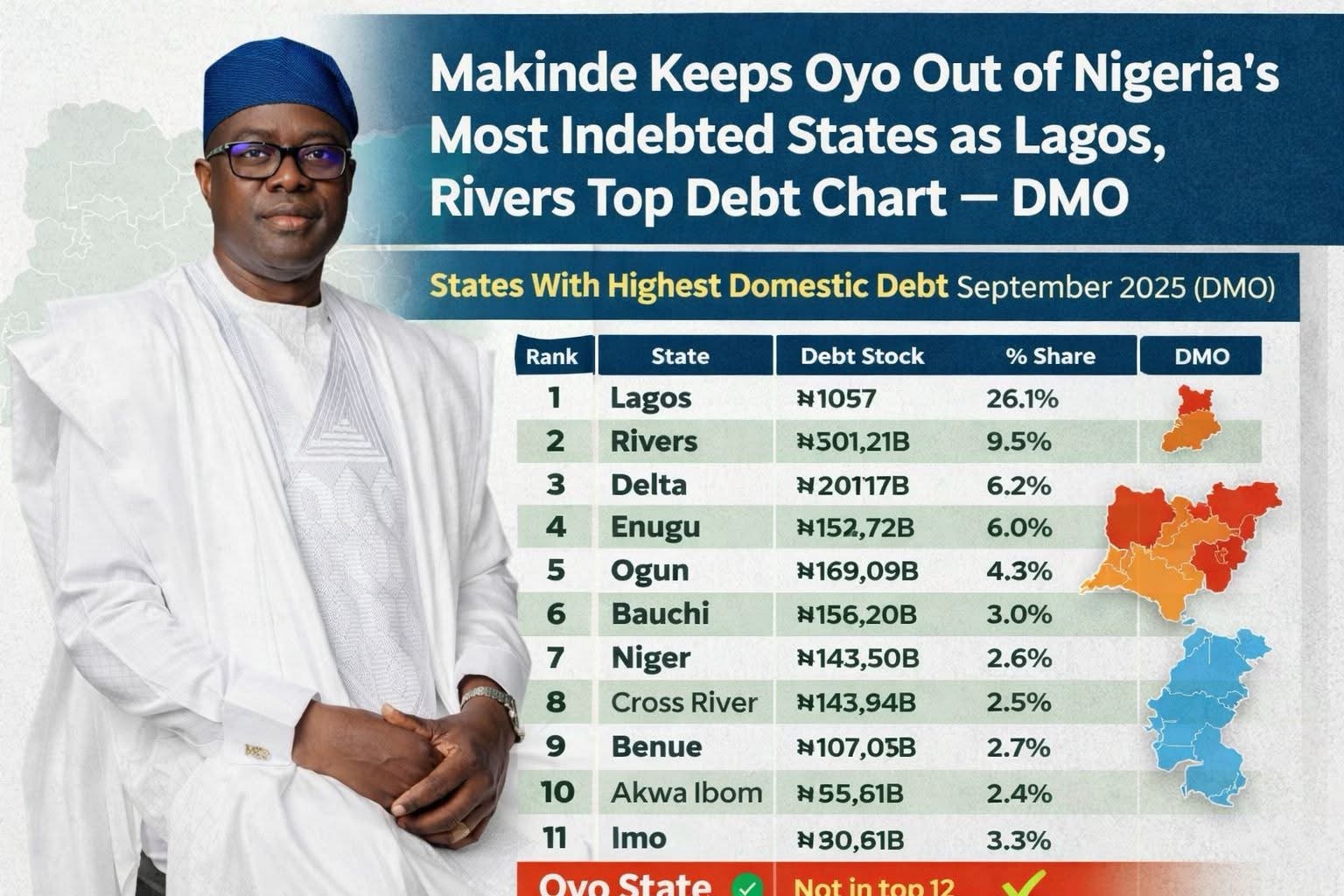
Oyo State has remained outside the list of Nigeria’s most indebted states, as fresh data from the Debt Management Office (DMO) shows that it did not rank among the 12 states with the highest domestic debt stock as of September 2025.
The figures, published by Statisense, reveal that Lagos State tops the chart with a domestic debt of ₦1.05 trillion, accounting for 26.1 percent of the total debt held by the listed states. Rivers State follows with ₦381.21 billion (9.5 percent), while Delta State ranks third with ₦247.17 billion (6.2 percent).
Other states on the list include Enugu State (₦194.72 billion), Ogun State (₦168.09 billion), Bauchi State (₦158.20 billion), Niger State (₦143.50 billion), Cross River State (₦141.94 billion), Benue State (₦107.25 billion), Akwa Ibom State (₦95.51 billion), Imo State (₦90.51 billion), and Taraba State (₦89.74 billion).
Notably, Oyo State did not feature on the list, a development that aligns with Governor Seyi Makinde’s long-standing stance on avoiding excessive borrowing. The administration has consistently emphasised fiscal discipline, focusing instead on boosting internally generated revenue, leveraging private sector participation, and adopting project-tied financing models.
Economic analysts say the state’s relatively moderate debt profile provides greater fiscal flexibility, allowing room for sustained investment in infrastructure, social services, and prompt settlement of obligations. This is particularly significant amid rising inflation and uncertainties surrounding federal allocations.
The DMO report also categorises the 12 states by geopolitical zones, with the South West represented by Lagos and Ogun; the South South by Rivers, Delta, Cross River, and Akwa Ibom; the South East by Enugu and Imo; the North Central by Niger and Benue; and the North East by Bauchi and Taraba.
While experts caution that borrowing is not inherently harmful, they warn that high debt service burdens can limit spending in critical sectors such as healthcare, education, and infrastructure—especially when not backed by strong revenue growth.
Oyo State’s absence from the high-debt ranking comes as the Makinde administration continues to advance its economic development strategy, with key focus areas including agribusiness expansion, solid minerals development, and infrastructure renewal under its Alternative Project Funding Approach.


Leave a Reply